
Understanding the finance labor market through real hiring demand
The finance labor market continues to play a foundational role in the global economy, supporting organizations across all industries and business models. Unlike more cyclical sectors, finance combines structural stability with gradual evolution in roles, skills, and organizational expectations.
This Finance Job Market Report Q1 2026 is based on the analysis of 86,435 finance-related job postings published globally during Q4 2025, collected and processed by PROSFY from public employment sources. The dataset reflects real employer demand, including offered salaries, required experience, education levels, job titles, requested skills, and geographic distribution.
By analyzing job postings directly, this approach captures how organizations structure their finance teams in real time and provides continuity with the previous Finance Job Market Report Q3 2025 allowing for consistent comparisons across regions and time periods.
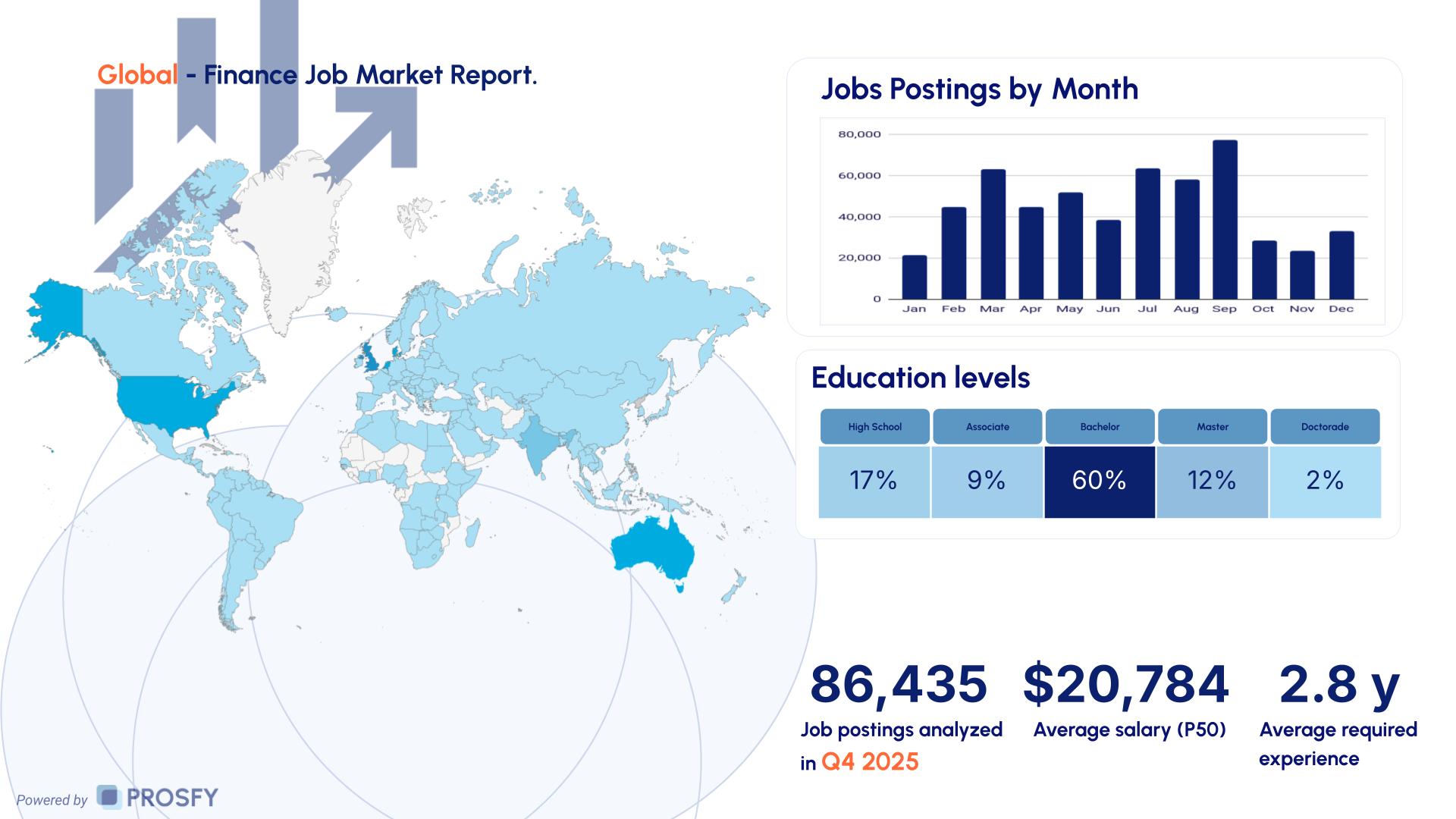
Global hiring volume and seasonal patterns
Monthly hiring activity in finance shows a clear seasonal pattern, though with lower volatility than technology-driven markets. Recruitment activity tends to increase after the start of the year, remain relatively stable through mid-year, and peak toward late summer and early autumn before moderating again at year-end.
These dynamics are closely linked to fiscal cycles, accounting closures, audit processes, and budget planning, all of which generate recurring demand for finance professionals at different moments throughout the year.
Experience requirements across finance roles
The global finance job market shows a strong orientation toward junior and mid-level profiles, with average required experience noticeably lower than in highly specialized technical sectors. A large share of job postings targets early-career professionals, particularly in accounting, finance administration, and support functions.
More senior profiles, such as controllers, finance managers, or specialized finance leaders, appear less frequently but carry higher responsibility and clearer differentiation in compensation. This structure reflects a broad base of operational roles with a narrower layer of senior decision-making positions.
Education requirements and access to finance roles
From an educational perspective, the finance labor market displays greater diversity than many specialized fields. While a bachelor’s degree remains the most common requirement, a significant share of postings accepts associate degrees, vocational education, or even secondary education for operational finance roles.
Advanced degrees, such as master’s or doctoral qualifications, are requested less frequently and are typically associated with higher-responsibility positions, advanced financial analysis, or management functions. This structure lowers entry barriers to finance careers while increasing competition at junior levels.
Salaries in finance: stability with moderate dispersion
Salary analysis based on the global median salary (P50) indicates that finance roles tend to offer stable compensation levels with relatively moderate dispersion. Compared to technology or highly specialized engineering roles, finance salaries show less volatility and fewer extreme outliers.
Compensation differences are primarily driven by role type, responsibility level, and regional context rather than short-term market fluctuations. Accounting and administrative roles tend to cluster around standardized salary ranges, while controlling, management, and specialized finance positions show greater variability.
👉 View the full salary benchmarking report at PROSFY
Most demanded finance roles globally
At a global level, the most demanded finance roles are strongly concentrated in accounting and financial operations. Positions such as accountant, accounting clerk, and accounting manager account for a substantial share of total postings.
This demand reflects the structural importance of financial record-keeping, compliance, and reporting across organizations of all sizes. More specialized or strategic finance roles appear less frequently but play a disproportionate role in governance and decision-making.
Key skills shaping the finance job market
The most frequently requested skills in finance job postings combine technical finance competencies and transversal skills. Accounting knowledge remains the core requirement, supported by strong demand for communication skills and proficiency in tools such as Microsoft Excel.
The prominence of communication skills reflects the growing interaction between finance teams and other business functions, as well as the need to translate financial data into actionable insights. English proficiency is particularly relevant in multinational environments and globally integrated finance teams.
Regional perspectives on finance hiring
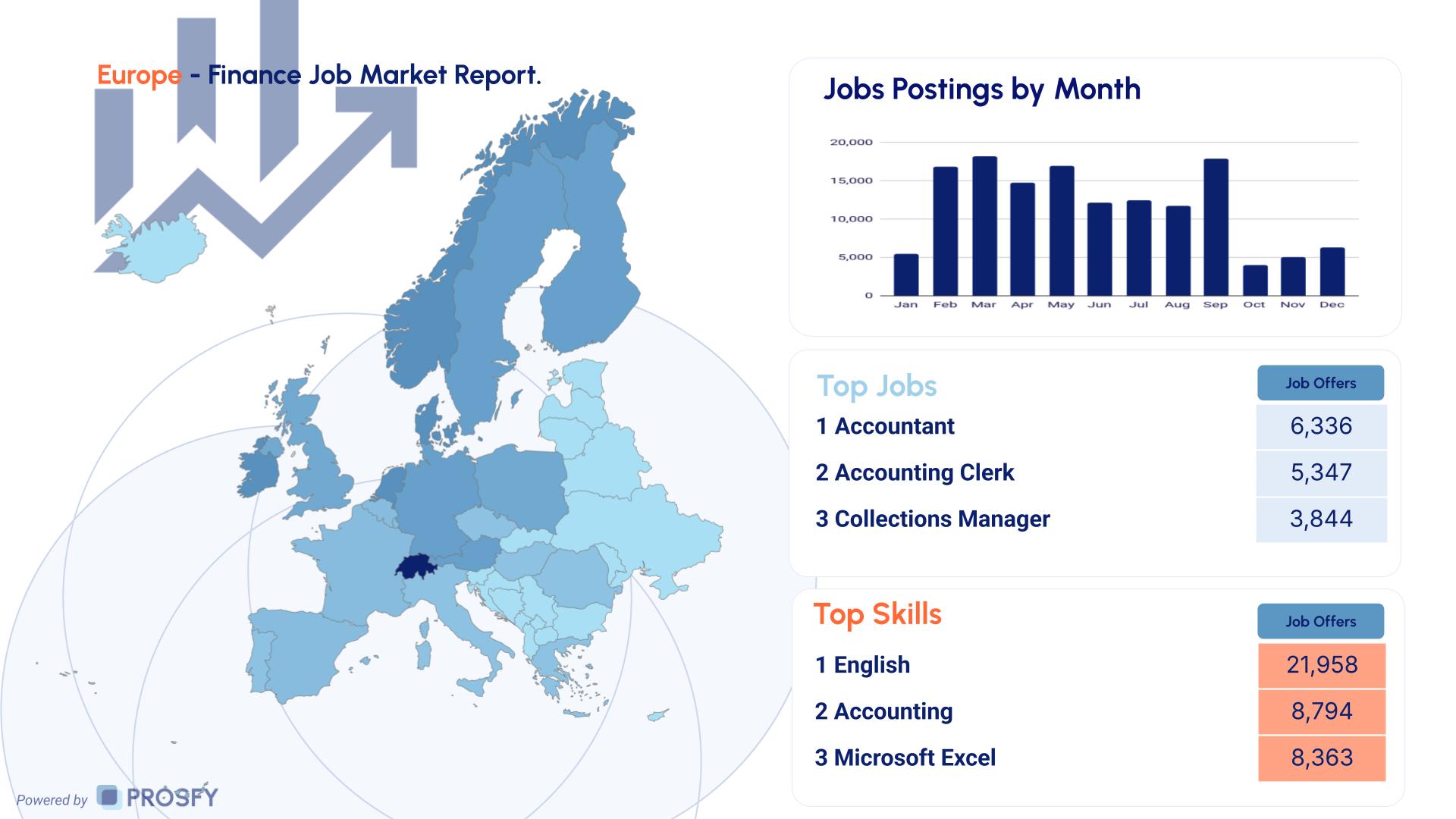
While global patterns are consistent, regional differences remain meaningful. Europe shows a strong concentration of accounting and collections-related roles, with high demand for English proficiency and traditional financial skill sets.
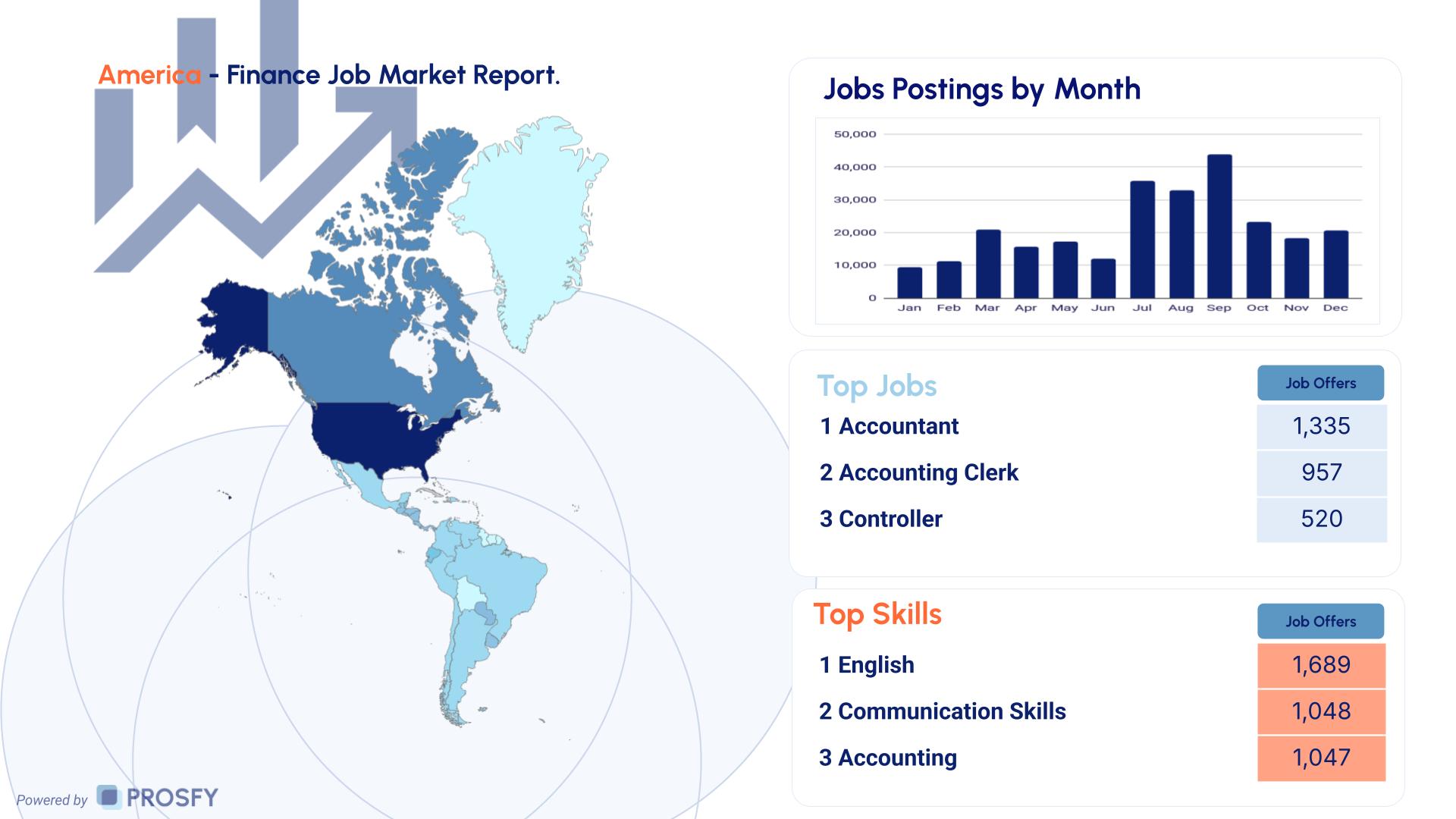
In the Americas, hiring volume is higher overall, driven largely by the United States. The region shows a similar structural emphasis on accounting and control, with a more visible presence of controller and finance management roles.
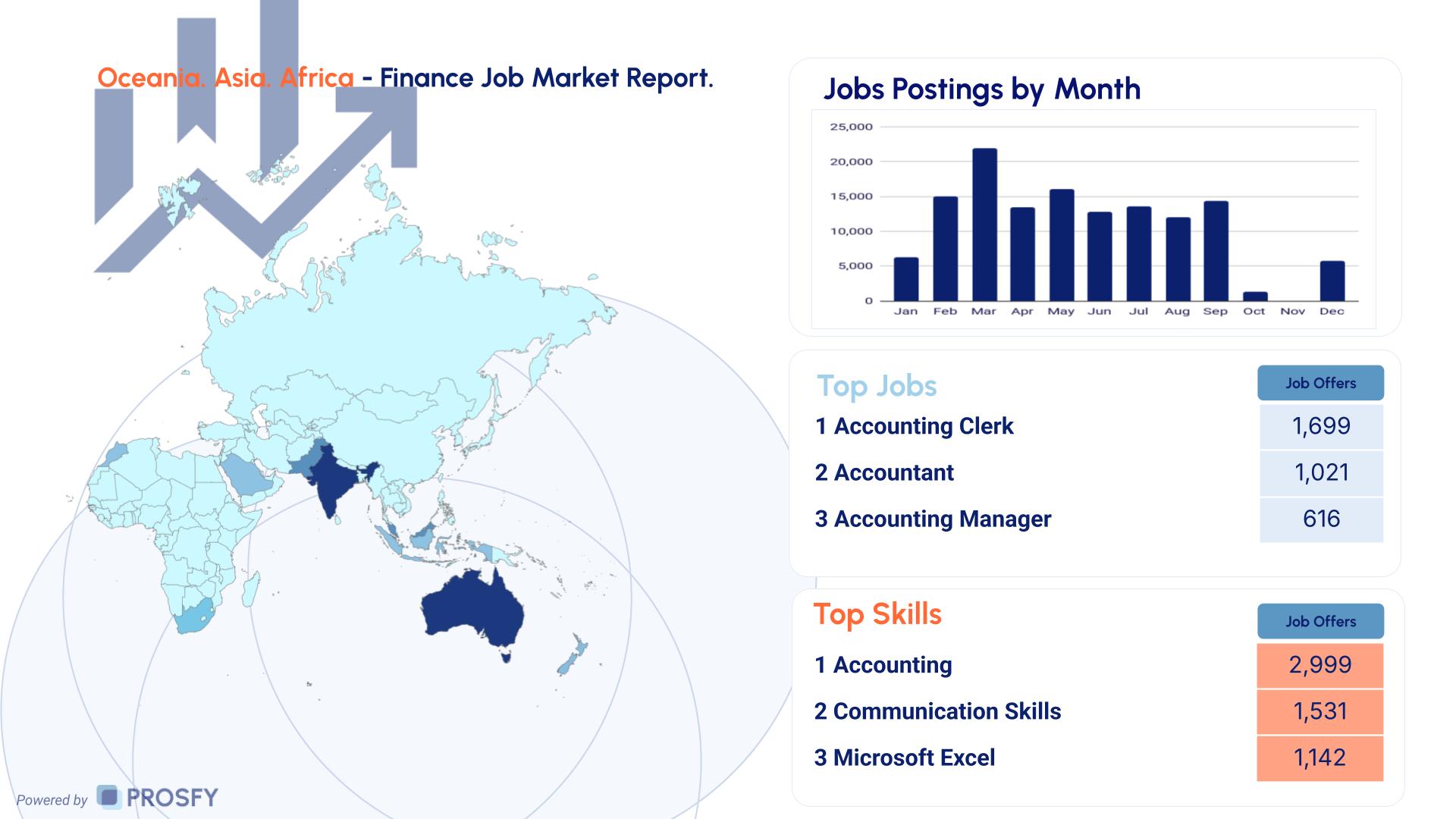
Across Oceania, Asia, and Africa, finance hiring reflects a mix of core accounting functions and operational finance roles, alongside growing demand for transversal skills and finance support profiles.
Implications for professionals and employers
For professionals, the data confirms that finance remains a reliable entry point into the labor market, particularly through accounting and administrative roles. However, long-term career and salary progression increasingly depend on specialization, accumulated experience, and, in some cases, advanced education.
For employers, the analysis highlights the importance of aligning role definitions, skill requirements, and compensation structures with real market conditions. Job posting data provides an objective benchmark for designing efficient and competitive finance teams.
Finance within the broader global labor market
The dynamics observed in the finance labor market align closely with broader employment trends identified in PROSFY’s global analyses. The sector’s stability, strong operational core, and progressive differentiation by specialization illustrate its role as a structural backbone of organizations.
Positioning finance within this wider labor market context helps distinguish temporary hiring fluctuations from long-term structural patterns.
Conclusion: a data-driven view of the global finance labor market
Analyzing the finance job market through more than 86,000 real job postings provides a solid, evidence-based view of current dynamics. The market remains stable and operationally driven, with strong demand for accounting roles, a junior-oriented experience structure, and progressive salary differentiation linked to responsibility and specialization.
This data-driven approach supports more informed decision-making for professionals, finance leaders, and HR teams. By systematically transforming job posting data into structured insights, PROSFY contributes to greater transparency and understanding of how the global finance labor market is evolving.
👉 Want to compare salaries in your sector? Check out our